

Porosity is your hair's ability to absorb and retain moisture. Depending on how open or closed your hair cuticles (the outer layer of your hair shaft) are, your hair will be more or less porous. This significantly impacts how you should care for and style your hair. There are three levels of porosity: low, medium (or normal), and high.
Low Porosity Hair
Low porosity hair has very tightly closed cuticles, which prevents water and products from easily penetrating the hair shaft. Low porosity hair is often smooth, shiny, and resilient, but it can also be dry, stiff, and difficult to style. It tends to accumulate product residue, which can weigh it down and make it dull.
To care for low porosity hair, you need to use heat sources (steam, hot towel, heating cap, etc.) to open the cuticles and promote hydration.
You should also favor products with a basic pH, which have the same effect. Avoid products that are too rich or too heavy, as they can suffocate the hair, and opt for light, moisturizing products, such as vegetable oils, floral waters, or aloe vera gels.
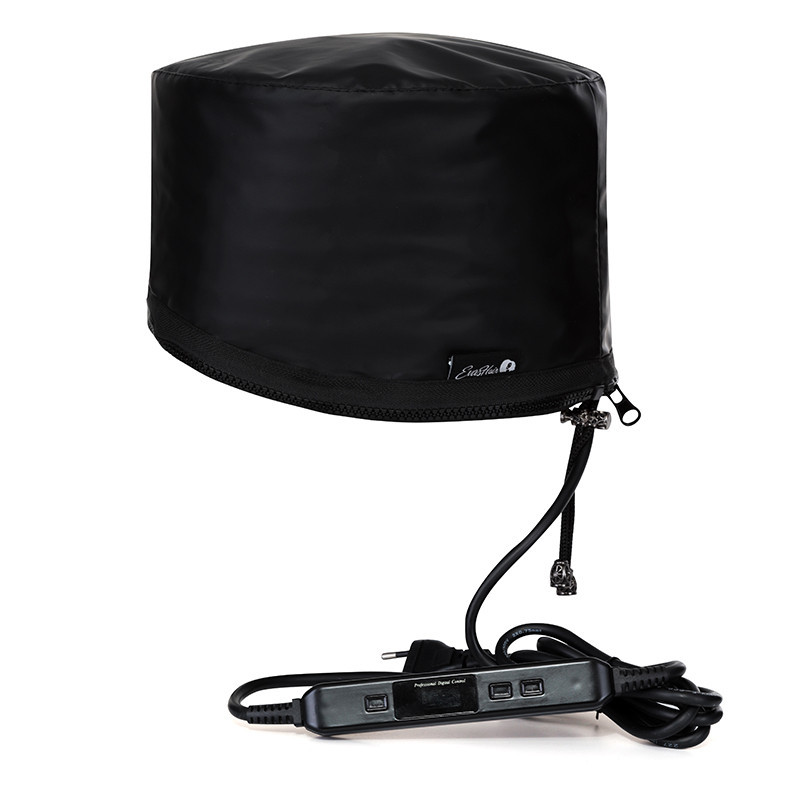
Eva's Hair Heating Cap
Medium Porosity Hair
Medium porosity hair has slightly open cuticles, which allows water and products to easily penetrate the hair shaft and remain there. Medium porosity hair is often supple, soft, and easy to style. It has good hydration and water retention capacity, which makes it elastic and resilient. It holds color and styles well.
To care for medium porosity hair, you need to maintain a good balance between hydration and nutrition. You should use products suited to your hair type, neither too rich nor too light, and alternate between moisturizing treatments (based on water, glycerin, aloe vera, etc.) and nourishing treatments (based on oils, butters, proteins, etc.).
High Porosity Hair
High porosity hair has very open, or even damaged, cuticles, which means water and products easily enter and exit the hair shaft. High porosity hair is often dry, brittle, and prone to split ends. It struggles to retain moisture, which makes it rough, dull, and fragile. It swells with humidity and shrinks when drying.
They quickly lose their color and shape. To care for high porosity hair, you need to hydrate it regularly and nourish it deeply. You should use products with an acidic pH, which will close the cuticles and seal in moisture.
You should also use protein treatments, which will strengthen the hair shaft and fill in gaps. Avoid heat sources, chemical treatments, and excessive manipulation, which can worsen porosity.
How to Determine Your Hair Porosity?
To determine yours, there are several tests you can do at home. The most well-known is the water glass test: you take a strand of clean, dry hair and immerse it in a glass of lukewarm water. If it floats on the surface, you have low porosity. If it sinks to the bottom, you have high porosity. If it remains in the middle, you have medium porosity.
However, this test is not always reliable, as it can be influenced by other factors, such as your hair's density or length. So, how else can you determine your porosity? There are other tests, such as the slide test or the spray test. The slide test involves running your fingers along a strand of hair, from the tip to the root. If you feel bumps or roughness, your cuticles are open, meaning your hair is porous. If you feel a smooth surface, it means your cuticles are closed, meaning your hair has low porosity.
The spray test involves misting a bit of water onto a section of your hair and observing how the water settles. If the water beads on your hair, it has low porosity. If the water is quickly absorbed, it has high porosity. If the water remains on the surface for a few minutes before being absorbed, it has medium porosity.
What Routine Should I Adopt for My Coily Hair Based on Porosity?
Once you know your porosity, you can adapt your hair care routine accordingly.
- Low porosity hair needs heat sources to open the cuticles and allow moisturizing products to penetrate. It also needs products with a basic pH, which promote cuticle opening.
- Porous hair, on the other hand, needs products with an acidic pH, which close the cuticles and seal in moisture. It also needs protein treatments to strengthen the hair shaft.
There you have it, I hope this post has shed some light on the porosity of coily hair. Feel free to tell me in the comments what your porosity is and how you care for it. And if you have any questions, I'm here to answer them.
See you soon!